

Window to understanding origin, culture of Owo Town
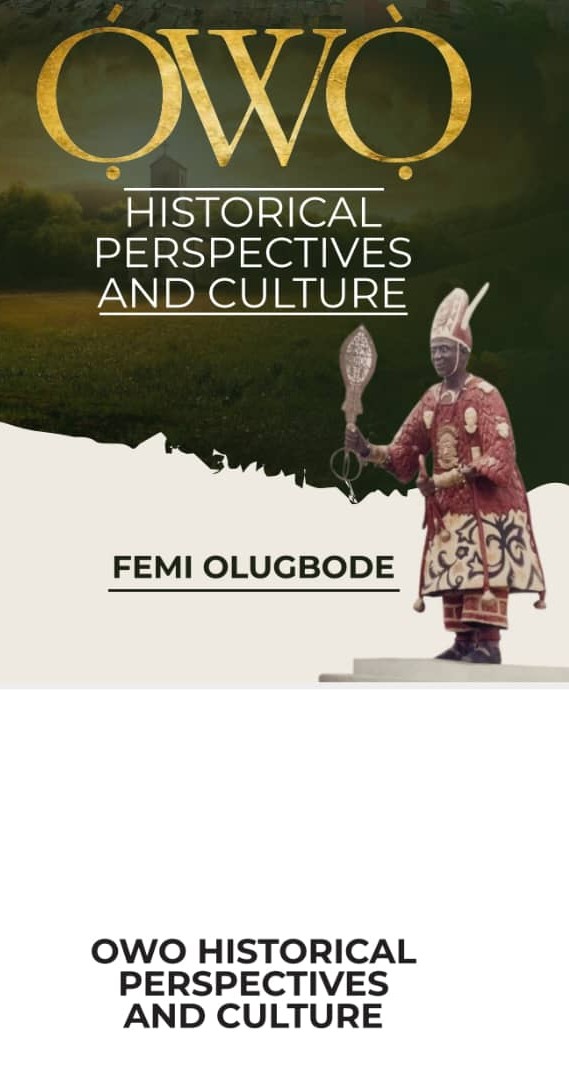
Book: Owo: Historical Perspectives and Culture
Author: Elder Olufemi Olugbode
Year Published: 2024
Reviewer: Felix Omoh-Asun
As the title of the book suggests, Owo: Historical Perspectives and Culture takes a panoramic view of the historical town of Owo in today Ondo State.
The book, authored by Elder Olufemi Olugbide, a retired military officer, provides a fascinating insight into how Owo came about , its progenitors, culture, beliefs and kingship.
The book is not just about the history and culture of a people but also about a people’s resilience to conquer obstacles and a make meaning out of the existential factors that surrounded them from the beginning. These existential factors became therapeutic that helped them to learn to accept responsibility for their lives and to live more nobly.
The author highlights the role played (still playing) by individuals in the building of the community to an enviable position that it occupies in annals of kingdoms in Nigeria.
True to the saying: “A nation is not its politics or economics. A nation is people. And a nation changes only when the people change.” Towards this end, the book throws light on the dynamics of the people who brought about changes through the instrumentality of the succeeding rulers with each bringing his charisma to bear to make the Owo what it is at present.
The author also talks briefly on some political figures like the late Chief Obafemi Awolowo and Chief Michael Adekunle Ajasin who helped to shape and put Owo on the front burners , politically.
Olugbode postulates that culture cannot be owned by a single community but assimilation of surrounding cultures.
In the first chapter, the book takes on the founders of Owo Empire, asserting that Owo Kingdom came into being around the 10th century or the 1st decade of the 11th century AD.
Tracing the historical movement, the book says Ojugbelu Aghanye left Ile Ife, the home of Oduduwa nation, accompanied by twelve elders known as Ighares, many youths called Ugbama on an expedition to find an area of influence for themselves. The migrants moved eastward to Ujin, where they were attacked by the aborigines there. Their stay was shortlived, because the ifa oracle told them to move further. From Ujin, they moved to Apafa hill (Okiti Apafa).
Another more probable account, the author says, Ojugbelu and his people lived at Okiti Apafa for a long time after Ujin. Unfortunately, Ojugbelu Alaghaye, the leader of the people, died and was buried at Okiti Apafa around 1070 AD.
His first son, Imade, took over the leadership of the people in 1070 AD. Prince Imade moved the people to Okiti Asegbo and changed the name to ‘Owo’, meaning ‘respect.’ He also established the title “Olowo,” meaning “He who deserves respect.” Therefore, Imade became the first Olowo of Owo and by extension Owo indigenes became known as Omo Olowo Imade, meaning the children of Owo who deserve respect, the book says. Under Imade, there was rapid development of the community which transformed it into a bubbling city.
Imade is credited with rapid expansion of Owo and had a telling impact on the generations after him
Chapter two is devoted to Oba Atanneye and the coming of Christian missionaries, including the establishment of the first community secondary school – Imade college, Owo. The chapter captures the struggle among different Christian dinominations to possess the soul of the people of Owo.
Chapter three deals with political participation, formation of Youths Association and formation of Action Group (AG), Ajasin and movement for the creation of Ondo state. It is also talks about Oba Sir Olateru Olagbegi II to the reigning Oba, Dr Ajibade Gbadegesin Ogunoye III.
Also, the power struggle among the ruling houses is not left untouched by the author. He lays the basis of what triggered the power struggle and the aftermath of triumphs and losses. Greed for power and unbridled ambition ruptured the power sharing formula put in place by the founding fathers of the community, the book admits
Chapter four is devoted to the Native Law, Custom and Culture of Owo people, creating the illusion and eroding allures of the “new world” of colonialism and its disruptive influencee over the cultural heritage of a people.
Going into marital responsibility of both the bride and groom, burial rites, among others, the book implies, obviously, that today’s Owo, like every community in Nigeria, is way off the culture and tradition of yester years.
Cultural festivals like Igogo, Egungun, Ulabi, are featured in this chapter. These festivals were ways of bringing the people together, whether within or without, to the good of the community.
In all, the 73-page book is spiced with empigramatic notes, giving each section a direction.
Pictorial pages with photos of some historical figures of the town add to the authenticity and facts about events captured in the book. Its rich annexure of dates and events is a plus to the book’s friendliness.
Written in a simple and everyday English, offered the book a companionship of every day people – the historians, history and anthropology students, the young, the old – and many who are interested in Owo history and culture.
Been a veteran journalist, who practised the trade for decades as a correspondent of the Nigerian Observer in Ekiti/Ondo, impacted on the diction of the book.
It’s worthy to know that Elder Olugbode has published Owo Voice Community newspaper from 2004 until date.