
Malami reacts after Obasanjo accused him of pardoning two corrupt ex-governors during Buhari’s govt
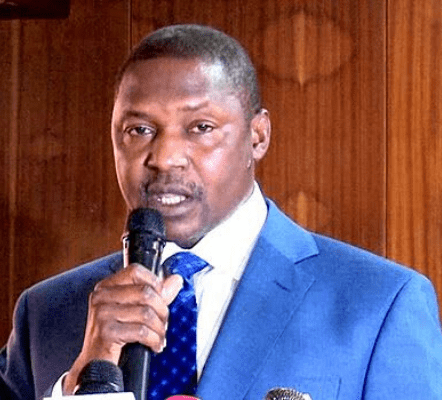
Malami
Former Attorney General of the Federation and Minister of Justice, Abubakar Malami, has defended himself against corruption allegations made by former President Olusegun Obasanjo in his newly released book, “Nigeria: Past and Future”.
Malami clarified that presidential pardons are handled by a designated committee, and his role as Attorney General was only to present the committee’s report.
In Obasanjo’s book, released in celebration of his 88th birthday, accused Malami of being instrumental in enabling corruption during former President Muhammadu Buhari’s administration.
He specifically cited the presidential pardons granted to former governors Joshua Dariye of Plateau State and Jolly Nyame of Taraba State, who had been convicted of fraud.
Dariye had been sentenced to 10 years in prison for embezzling ₦1.126 billion, while Nyame was serving a 12-year sentence for misappropriating ₦1.64 billion. In April 2022, the Council of State, led by Buhari, pardoned both men on the grounds of age and ill health.
However, Obasanjo claimed that the medical justifications for their release were false and that Malami had manipulated the process for financial gain.
Obasanjo accused Malami of using various corrupt schemes for personal benefit, alleging that Buhari tolerated and even enabled such practices under his administration.
In response, Malami rejected the allegations, insisting that the presidential pardon process is governed by law and does not fall under the direct control of the Attorney General. He explained that a committee on the prerogative of mercy is responsible for making recommendations, and the final decision is made by the Council of State.
Malami criticized the trend of making baseless corruption allegations against public officials and called for evidence-based claims to ensure credibility.
He referenced past accusations against Nigerian presidents, including Obasanjo, during international media engagements, citing Obasanjo’s Hard Talk interview as an example.
He emphasised that corruption allegations should be supported with concrete evidence rather than speculation.
“It is only reasonable to provide adequate particulars where allegations of corruption are made. Who gives what? How much was given? Who facilitated the bribery? Through what medium was the bribe given? On what date and time? These details are always necessary to establish reasonable suspicion,” Malami said.
Speaking further, Malami concluded that allegations lacking such specific answers remain baseless, mischievous, and devoid of actionable grounds for legal pursuit.