
National Librarian, Anunobi faces probe over procurement, recruitment fraud

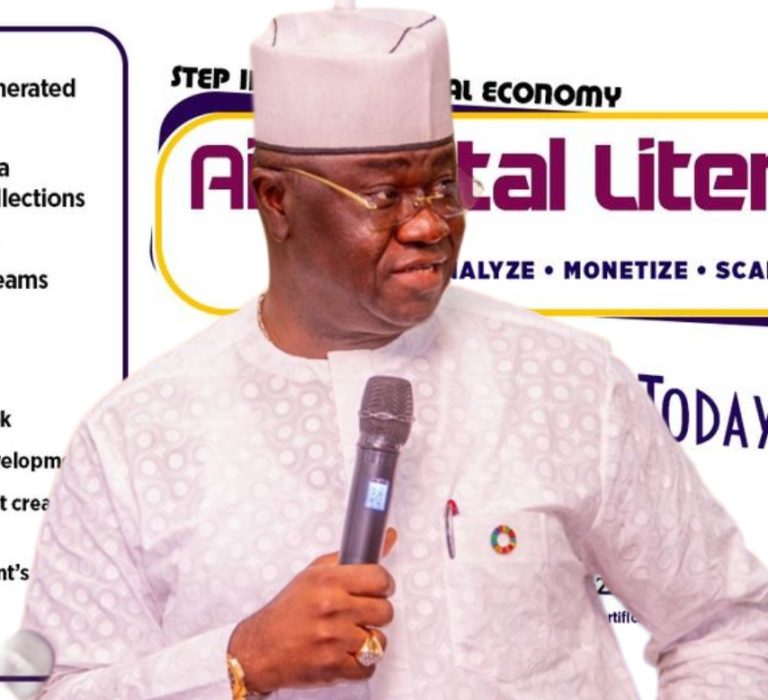
Anunobi, CEO NLN
The Independent Corrupt Practices and Other Related Offences Commission (ICPC) is currently probing the National Librarian and Chief Executive Officer of the National Library of Nigeria (NLN), Chinwe Anunobi, over allegations bordering on procurement fraud, employment racketeering, and abuse of office, The ICIR can authoritatively report.
The development follows a 2023 petition filed with the commission, prompting an initial investigation that was concluded in 2024. The petition submitted by the in-house union of workers, obtained by The ICIR, accuses the agency’s leadership of systemic corruption, including the inflation of contracts, diversion of public funds, breach of procurement laws, and sale of employment slots.
Titled, “Acts of Corruption, Contract Inflation, and Violation of Public Procurement Act 2007”, it was also submitted to the Minister of Education. It outlined how millions of naira were allegedly funnelled through irregular transactions, including the use of staff personal accounts and contracts awarded without due process.
The ICPC spokesperson, Demola Bakare, confirmed that after the matter was reviewed by the commission’s legal department for possible prosecution, it was returned for reinvestigation in 2025.
The renewed probe followed months of tension within the NLN, where insiders said corruption and mismanagement have become entrenched, leaving staff disillusioned and afraid to speak out.
Some who voiced out were said to be witch-hunted by the management of the National Library and subjected to unfair treatment in the agency.
The ICPC confirmed four victims of this alleged harassment, noting that it has communicated the cases to the Ministry of Education for possible protection of the whistleblowers.
However, for some of the staffers, the probe has dragged for too long and has placed them in a very tight spot, allegations denied by the agency’s spokesperson.
While the ICPC has not yet disclosed details of the investigations and the initial outcomes, The ICIR gathered that central to the allegations against the National Librarian is the procurement of two JAC Frison 4×4 pickup vehicles at a cost of N62.6 million.
According to the petition, the National Library relied on a Certificate of No Objection issued by the Bureau of Public Procurement (BPP) in February 2022 for an entirely different set of vehicles and suppliers.
Despite the BPP approving selective tendering for companies such as Lanre Shittu Motors, and Globe Motors, the vehicles eventually purchased were from a different brand and supplier not covered by the waiver.
“There was no advertisement for this purchase,” the petition states, adding, “No other company was invited to bid except Elizade AutoLand, from whom the vehicles were eventually procured. Worse still, the vehicles bought were completely different from the specifications approved in the BPP certificate.”
According to Nigeria’s Public Procurement Act, 2007, all government ministries, departments, and agencies (MDAs) must adopt competitive bidding for procurement above ₦2.5 million (goods) or ₦5 million (work).
The union also alleged that a forged proforma invoice bearing the name of Lanre Shittu Motors was inserted into the procurement file to simulate a competitive process.
The petitioners indicated that this amount was inflated by N14 million when compared against independent market rates for identical vehicles.
In the document attached to the petition, the union got an invoice for the two vehicles from the same vendor to be N48.3million, including VAT. Each car was sold for N22,500,000 and VAT of 7.5 per cent on the two vehicles for N3.3 million.
The ICIR gathered that the invoice for the vehicle was obtained by the union just a few days after the contract was awarded. The petition noted that the contract was awarded on February 18, while the invoice was dated February 20.
When The ICIR reached out to the agency on these allegations, the spokesperson Orviel Dio, said the cost of the project was estimated to include all the statutory deductions which, according to him, amount to about 13 per cent of the total contract sum.
In practical terms, ‘13 per cent statutory deductions’, are often referred to a bundled average for supply contracts, which combines WHT, stamp duty, and some other levies (sometimes rounded up).
While the contract was awarded at ₦62,649,710, the petitioners alleged that the actual market cost for the two vehicles from the same vendors, including 7.5 per cent VAT, was N48.3 million, a difference of ₦14.35 million.
However, after statutory deductions of about 13 per cent (₦8.14 million) by the Office of the Accountant-General, the contractor would have received approximately ₦54.51 million. This still leaves a gap of ₦6.21 million between the petitioners’ claimed cost and the net amount paid to the supplier.
Speaking on the selection process and the BPP waiver, Dio maintained that the agency had provided ‘justifiable reasons’ for seeking selective bidding, which led the BPP to grant the waiver. However, he failed to clearly explain why Elizade AutoLand, a supplier allegedly not listed in the waiver, was eventually awarded the contract.
Under Nigeria’s Public Procurement Act, 2007, the BPP may grant a waiver for selective or restricted tendering in cases where goods or services are only available from a limited number of suppliers, where time is of the essence due to emergency, or where previous procurement processes have failed to produce a suitable contractor.
The ICIR gathered that even with such a waiver, procurement rules still require strict adherence to the list of approved suppliers and specifications outlined in the exemption.
Meanwhile, a similar pattern characterised other procurements listed in the petition, including 2022 digitising process.
Beyond the financial impropriety, there are strong allegations that the National Library flouted federal character principles during employment processes.
Sources noted that slots were routinely sold for as much as ₦2 million, with intermediaries allegedly linked to Anunobi overseeing the transactions.
“One of the aggrieved instituted a case at Zone 4 Division of Nigeria Police in Kubwa, which led to the arrest of the Special Adviser to the National Librarian, right in the office along with other staff and they were held in custody for days,” the union’s petition read, noting that no disciplinary action has been taken against the accused till date.
The petition also accused the National Library of violating federal character principles, claiming that most of the vacancies in the recent recruitment exercise were filled by individuals from the South-East.
The Library’s spokesperson dismissed allegations of favouritism in its recent recruitment exercises in 2023\2024, explaining that the Civil Service Commission had granted the institution a waiver to hire based on pressing manpower needs. He noted that the recruitments may have been perceived as biased because certain branches with significantly lower staff strength were given priority in filling vacancies.
According to him, this approach was aimed at balancing personnel distribution across the library’s network rather than favouring specific individuals.
Other alleged financial irregularities highlighted by the petitioners involve funnelling of substantial public funds directly into staff personal bank accounts.
The petition showed how ₦33,692,982.25 were paid to a staff personal account, in violation of Nigeria’s Public Sector Financial Regulation Act.
The money which was paid in four segments ranges from N15 million to N918,000 for projects which sources claimed were not accounted for.
Payment vouchers for August 2022 seen by The ICIR confirm that funds were funnelled into the personal account of Kalu O.I, a director of virtual library service development, for projects related to readership promotion.
Readership promotion refers to a set of activities and programmes designed to encourage and improve the culture of reading among Nigerians annually. It is typically spearheaded by the National Library of Nigeria and sometimes in collaboration with schools, media, NGOs, and government agencies.
For instance, on August 22, 2022, a payment voucher was issued for the sum of ₦11,285,000 paid into Kalu’s account for ‘Head of Branches kick-off/preparation for the conduct of the 2022 readership promotion campaign (RPC).
Also on the same date, Kalu received ₦15,570,000 into her account for what the voucher described as ‘printing of materials and banners for the forthcoming readership promotion campaign.’
Dio, while justifying the payment, said the reason for making payments into staff accounts was that some projects are best executed by in-house staff and do not need to be outsourced to contractors.
According to him, the payment for that particular project was intended to be distributed to other branch heads to purchase books and other materials for the readership promotion campaign.
Also, the petitions alleged that over ₦67.9 million released for the 2022 digitisation of weak and rare materials were spent without any tangible outcome.
The petition claimed that the only traceable result related to digitisation was work carried out by staff using a Robot Scanner procured under a former administration.
Despite the large sum, the petitioners stated there is no evidence of significant progress in digitisation, while departments such as Accounts and Human Resources still operate manually.