
Soyinka condemns Tinubu’s military deployment in Benin Republic, says he should ‘ve sent his son, Seyi
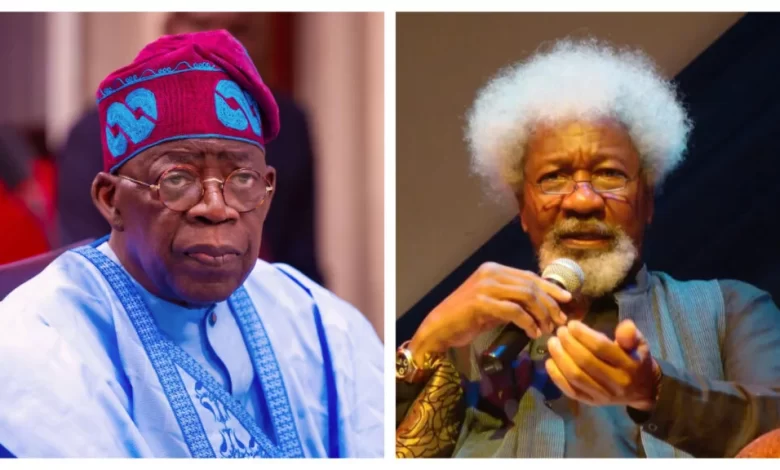
Nobel Laureate, Prof. Wole Soyinka, has criticised President Bola Ahmed Tinubu over Nigeria’s military involvement in the recently foiled coup attempt in the Republic of Benin.
Speaking in Lagos at the 20th Wole Soyinka Centre for Investigative Journalism (WSCIJ) Awards, the literary icon warned that such interventions could have serious implications for regional stability and Nigeria’s internal security.
Soyinka reflected on governance failures, human rights concerns, worsening insecurity, and the growing danger of misinformation in the digital age.
He described Nigeria’s role in Benin as “another needless military entanglement next door,” insisting that the incident should serve as a wake-up call for the country to strengthen its democratic institutions rather than rely on military force as a first response.
Soyinka noted that political unrest in any neighbouring country inevitably affects Nigeria.
“What happens in Benin inevitably affects us. Instability anywhere in the region echoes within our own sense of security,” he said.
Soyinka further raised concerns about what he described as an excessively large security detail assigned to a young individual close to the presidency, saying the entourage appeared large enough “to take over a small country.”
He questioned why a non-government official should be surrounded by such a formidable formation, describing it as a troubling misuse of state security resources.
“Children must understand their place. They are not elected leaders and must not inherit the instruments of state power simply by proximity,” he said.
Soyinka argued that the president had other options before turning to the Air Force, adding that the scale of the response was unnecessary.
He referenced a recent experience he had in Lagos involving Seyi Tinubu, saying the level of security around the President’s son was enough to “quell” the failed uprising in Benin.
According to him, Nigeria did not need to mobilise fighter jets or troops to address what he described as an “insurrection to our sense of security.”
He insisted that Tinubu could have drawn from his own security circle rather than sending the military across the border.
Soyinka narrated how he encountered Seyi Tinubu during a visit to a hotel in Ikoyi. He said he was surprised to see a large security presence on the premises, only to later discover that the personnel were attached to Seyi.
He said: “President Tinubu didn’t have to send the Air Force and military to deal with the insurrection to our sense of security and equilibrium; no there are easier ways of doing it.
“Let me tell you where Tinubu should have looked for forces to quell that insurrection, right here in Lagos or in Abuja perhaps, but there was no need to call the military or the Air Force.
“I will tell you what happened in one of my home visits just two months ago, I was coming out of a hotel and I saw what looked like a film set, a young man detached himself from the actors and came over to greet me very nicely politely.
“I looked around and there was nearly a whole battalion occupying the ground of that hotel in Ikoyi. So I got back in my car and asked who that young man was and he told me.
“I saw the SWAT team, a mixture of heavily armed, at least 15 heavily armed to the teeth security personnel, looked sufficient to take over a small neighbouring country like Benin.
“I think the next time the president should just call and say ‘Seyi go and quell the rebellion over there’. I was so astonished that I started looking for the NSA.”
Turning to the media, Soyinka commended journalists for their resilience but called for stronger editorial discipline as misinformation continues to spread rapidly online. He warned that unchecked falsehoods could one day trigger global instability.
He added that responsible journalism — grounded in truth, verification, and professional integrity — remains the nation’s strongest defence against chaos.