

Dangote Refinery laments crude shortfall, says Nigeria accounts for 30% of needed volumes
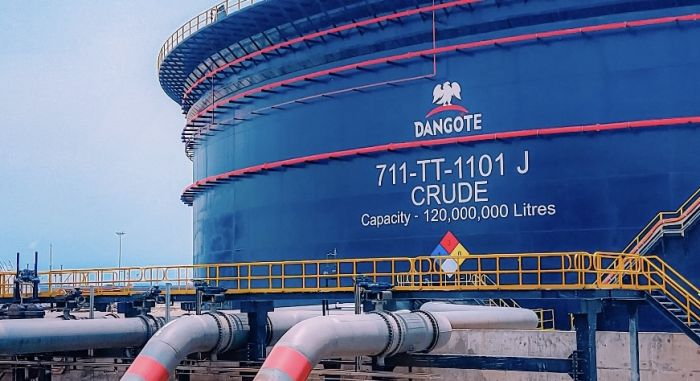
The Chief Executive Officer and Managing Director of the Dangote Refinery, David Bird, yesterday raised concerns over Nigeria’s inability to supply sufficient crude oil to the facility, disclosing that deliveries under the government’s crude supply arrangement are falling significantly short of agreed volumes.
Speaking in an interview on Arise Television, Bird said the refinery, which is currently operating at its full capacity of 650,000 barrels per day, requires between 13 and 15 cargoes of crude monthly to meet domestic fuel demand. However, he said the refinery is only receiving about five cargoes, representing just about 30 per cent of expected supply, ThisDay newspaper reports.
He explained that the gap undermines the effectiveness of the Crude-for-Naira arrangement, a policy designed to supply crude to local refiners at international prices but without foreign exchange exposure.
According to him, while the initiative has helped stabilise Nigeria’s foreign exchange pressures, its implementation has been inconsistent, particularly in terms of both volume and crude quality allocation.
“We have been very vocal that there is an existing arrangement in place under the Crude-for-Naira programme commonly misunderstood as a pricing regime, it is not. It is priced at full international benchmark crude oil pricing, however, without the foreign exchange implication.
“That has been very successful in stabilising the FX and I think Nigeria and our relationship with NNPC and Dangote, we should all be very proud of that. That agreement, however, is not only just from volume but also a quality allocation perspective not being met.
“And our demand of the government is just to be transparent with that allocation methodology because what we see under that agreement, we should be getting about 13 to 15 cargos a month and that’s what we could process to meet the domestic fuel requirements of Nigeria. Currently we’re only getting five.
“So that’s an underperformance against that pre-agreed volume contract. Second to that is quality. So Nigeria has a wide variety of crude grades all exported from different terminals and we have a preference,” he stressed.
Bird noted that the refinery’s hardware is optimised for specific crude slates, and while it can process a range of Nigerian grades, consistent supply of preferred blends is essential for efficiency. The failure to meet these specifications, he said, has forced the refinery to turn to international markets.
In a development he described as troubling, Bird disclosed that the same Nigerian crude grades not allocated to the refinery are being sold on the global market, where the company is then compelled to repurchase them in dollars at significant premiums.
“However, given our preference for Nigerian grades, we go back into the international market and we find those very same grades that we have preferenced that were denied to us now being offered on the international market in US dollars.
“And so we do purchase those and right now there’s obviously a global thirst for crude, no matter where it comes from. So that has meant there’s a significant premium being attached to Nigerian crude grades upwards of $18 a barrel premium for those same Nigerian crude grades.
“So 30-35 per cent under Crude-for-Naira, we get allocated with no discount, no subsidy. It is international benchmark pricing. Then we have to pay international benchmark freight rates and freight has also been severely impacted and gone up, insurance rates, etc. So there is a misunderstanding that the Crude-for-Naira programme is somehow a discount or a subsidy. It is not. There’s arm’s length relationship.
“We purchase that crude, we transport that crude, we insure that crude as if we are fully arm’s length at international benchmark pricing. And every one of those cost inputs has been impacted by this crisis. Then we’re still finding and so far we continue to see those other Nigerian crude grades appearing on the market and we’re still willing to pay that premium.
“However, it’s disappointing that it’s coming back to us on the open market and that value between the purchase price and the premium that we’re now seeing is money that Nigeria is leaking to the international trading community and we believe that is unnecessary and would like to understand the allocation methodology,” he stressed.
This, he added, represents a loss of value to Nigeria, as the margin between the domestic allocation price and international resale accrues to foreign traders rather than the local economy.
Despite the supply constraints, Bird said the refinery has relied on its flexible design to source alternative crude from the international market, with between 30 and 40 per cent of its feedstock now coming from foreign sources.
He credited the vision of Aliko Dangote for building a refinery capable of processing a wide variety of crude types, noting that this flexibility has helped sustain operations despite domestic supply challenges.
However, he warned that reliance on international crude exposes the refinery fully to global market volatility, particularly amid the ongoing tensions in the Middle East, which have driven up crude prices, freight costs and insurance rates.
“These cost pressures are across the board, not just crude prices, but logistics, shipping and even supplier contracts,” Bird said, adding that such increases inevitably feed into the final cost of refined products.
Addressing concerns over rising petrol prices, he maintained that the refinery operates on a fully commercial basis, with no subsidy or discount on crude inputs. As a result, pricing is directly influenced by global market conditions.
He explained that while the refinery tries to maintain price stability within a commercially viable range, sustained increases in input costs make it difficult to shield consumers entirely from global shocks.
Bird also pushed back against the perception that the Crude-for-Naira programme provides preferential pricing to the refinery, stressing that crude is purchased at full international benchmark rates, with the only benefit being reduced exposure to foreign exchange transactions.
He called for greater transparency in how crude allocations are determined, arguing that a clearer and more consistent framework would improve efficiency and reduce unnecessary costs within the system.
Beyond crude supply, he pointed to other structural challenges, including regulatory charges and the general cost of doing business, urging the government to take a more holistic approach to supporting domestic refining.
He noted that fuel prices remain one of the most visible indicators of economic pressure for households, reflecting cost-of-living challenges driven by global energy dynamics.
While acknowledging the strain on consumers, Bird expressed optimism that fuel prices would eventually moderate, noting that the oil market is ‘cyclical’ and that periods of high prices are typically followed by corrections.
“What goes up always comes down,” he said, adding that the refinery’s focus is on maintaining efficiency and resilience through both upturns and downturns in the market.
He emphasised that Nigeria remains in a relatively advantageous position globally, given its crude resources and growing domestic refining capacity, but warned that maximising these advantages depends on resolving supply inefficiencies and strengthening coordination across the oil value chain.